


Picture this: you’ve played for your country, emptied yourself in the minutes you were given. You walk back into the dressing room, shoulders heavy, the silence thick due to the disappointment of not getting the needed result. Then, minutes later, you reach for your phone, and there it is. Not from the press, pundits, but your own federation. The very body that called you up, that put the shirt on your back, is now publishing a match report that singles you out, twisting the knife when it should be the shield.
That is the bizarre, self-destructive reality of Nigerian football.
For many players, representing the national team is a source of real pride. Whenever the chance comes, the excitement is the same, even if it amounts to just a handful of minutes on the pitch.
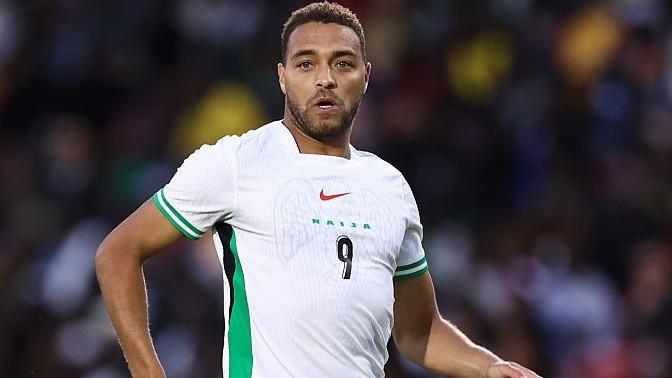
After Nigeria failed to beat South Africa in Tuesday’s World Cup qualifier in Bloemfontein, a familiar pattern played out. The NFF’s communications department released its report, and within it came a pointed line about Cyriel Dessers. Yes, he had not enjoyed his best game, but it was not the federation’s business to be saying so.
Master at Throwing Their Own Under the Bus
The Nigeria Football Federation’s communications department has turned itself into a public flogging ground for national team players, and it cuts across both genders.


Let’s start with a Falcon. Desire Oparanozie, a striker who gave so much to the Super Falcons, was dismissed with brutal simplicity.
In a tournament in 2021, the Aisha Buhari Cup, they described her performance: “most awful on the evening, squandering a half-dozen opportunities, easily conceding possession and literally playing against her own team.” That’s not analysis, but an attack, in broad daylight, carrying the federation’s seal of approval.
They Didn’t Spare Leonard Ngenge
Fast forward to August 2025, Leonard Ngenge, a young defender with the CHAN Eagles, had just been on the wrong end of a 4-0 defeat to Sudan and was then torn apart by his own federation.


“ Defender Leonard Ngenge, culpable for his infamous walking pace,’’ the report read, ridiculing him before going on to list his own goal and a handball. “Setting the stage for a rout that left ball fans aghast,’’ it added, as if the point of a match report was to humiliate, not to inform. That was appalling.
And then the recent one, just on Tuesday, was Cyriel Dessers, a striker still trying to carve his way into the Super Eagles’ setup, described as “a substitute that was substituted,” with the damning summary that he “did little in bringing alive the Nigerian attack.”
You read the lines multiple times, just to be sure you’re not imagining it. But no, that was the NFF’s official communication, the supposed guardian of Nigerian football’s image, setting fire to its own players. Something that’s now becoming a familiar pattern.


What sense does this make? What strategy sits behind it? In what world does an organization gain by tearing down its own players in public? Desire Oparanozie, who gave her peak years to the Falcons, reduced to ‘most awful.’ A home-based young defender, trying to find his feet, got dismissed for an ‘infamous walking pace.’ A striker still settling into the national team mocked as a ‘substitute that was substituted’. It reads like a hit job.
A Shocked Nigeria Football Federation Shows Hierachy Weakness
And here is the thing, the NFF knows this is unacceptable. General Secretary, Mohammed Sanusi, himself admitted as much when he scrambled to distance the body from the words. “Nobody in the headquarters was happy with that release,” he said. “It was not directed by the NFF. Nobody was happy that an individual is singled out”.
If that is true, then what does that say about the NFF’s structure? What does it say about a federation so disorganized that its communications team can run wild, publish official statements globally, and only afterwards does headquarters claim ignorance?
You cannot be both the federation and not the federation. Either you take responsibility for what goes out under your name, or you admit you are not in control of your own shop. Both explanations are damning.
And make no mistake, this isn’t harmless clumsiness. Words matter. A player’s reputation lives and dies in the small details of how they are perceived. An international footballer does not need their own federation, of all people, branding them “hapless” or “most awful.” That sticks. It lingers.
It is, quite simply, stupid. Stupid because no serious federation behaves this way. Also, stupid because Nigeria already has a hostile enough football culture, where fans turn quickly on players for their failures. Stupid because the federation should be the shield, not the spear. Federations protect, they absorb blame, they redirect anger. The NFF, instead, has chosen to join the mob.
And it is cowardly, too. Cowardly because it singles out individuals in a team sport, where defeat is always collective.
Worse still, it exposes the federation’s complete lack of professionalism. Communication in modern football is not just about writing words; it is about managing the narratives and protecting brand value.
Nigeria Football Federation: Poor Crisis Communication
Players are assets, not only in footballing terms but financial ones too. Every time the NFF tears down one of its own, it chips away at that value. It poisons relationships with players, alienates fans, and showcases the dysfunction to the world.
This is why it cuts deeper than embarrassment. It’s not just a ‘poor choice of words. It’s the symptom of a federation that doesn’t understand its role. A federation that has turned its own mouthpiece into a tool for ridicule rather than support.
The irony, of course, is that Sanusi’s attempt at damage control only highlighted the problem. He said the government delegation had encouraged the players after the defeat, urging them to look ahead. Fine. But what good is that if, at the same time, your own federation’s media team is tearing into them in front of the whole country? One arm pats you on the back, the other slips a knife between your ribs.
There is something deeply damaging in this culture, and if the Nigeria Football Federation doesn’t change it, the fallout won’t just be reputational. Dual nationals weigh their options, and if one of those options is a federation that publicly humiliates its own, why would they choose it? Nigeria already struggles to convince talent born abroad to commit; behaviour like this only hardens the doubts.
Players miss chances. Defenders make mistakes. Strikers struggle. That is football. But when the people in charge respond not with support, not with accountability, but with public shaming, that is something far worse.
That is betrayal. And for all the chaos we have come to expect from the Nigeria Football Federation, this culture of throwing their own under the bus makes no sense.